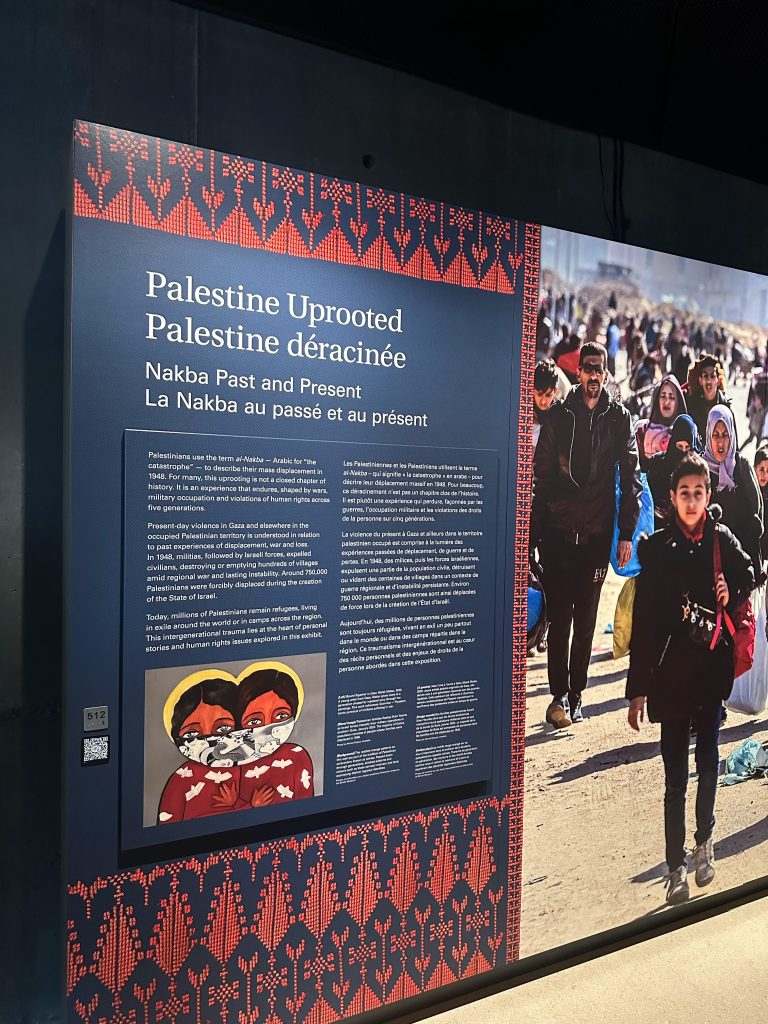
I have been reflecting on the opening of the exhibit, “Palestine Uprooted: Nakba Past and Present”, at the Canadian Museum for Human Rights in Winnipeg, Manitoba. It is hard to fully put into words my reflections, but I will try.
It was an honour to attend the opening of the exhibit with dear friends, colleagues, and comrades in the solidarity movement for Palestinian liberation. To spend time with like-minded folks who care deeply about Palestinian life, humanity, and dignity was healing and strengthening. And to be greeted by and meet the Palestinian community members who pushed for this exhibit to exist in the first place was the highest honour one could experience at such an event and occasion.
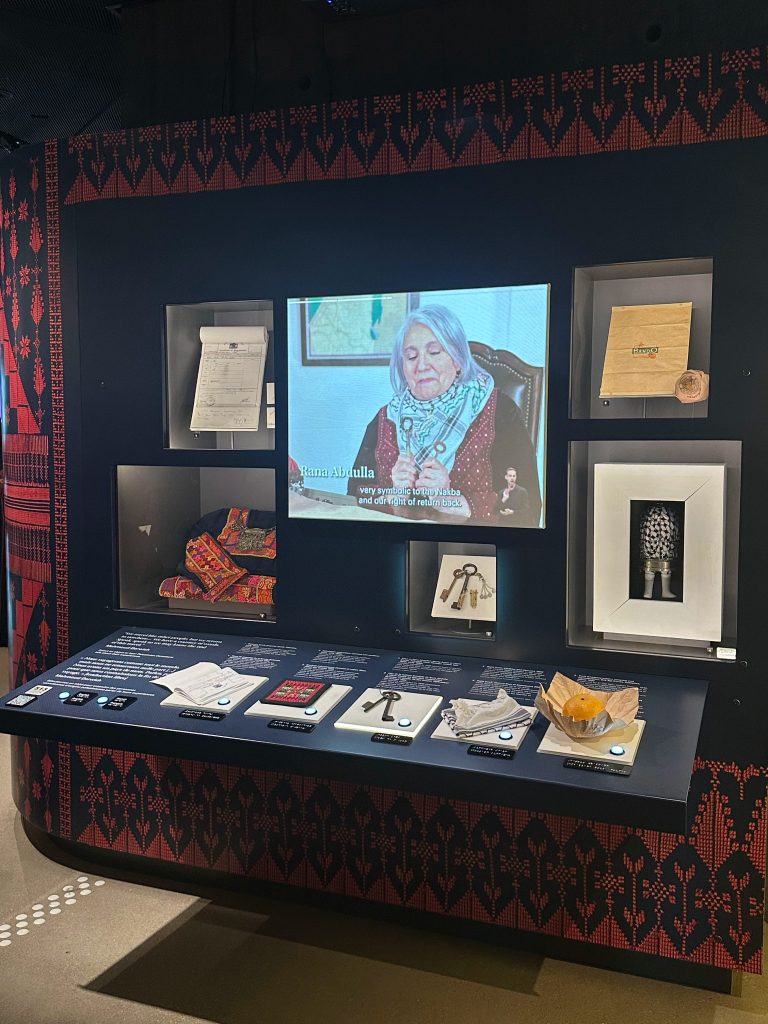
The exhibit itself is a modest one. Comprising of a rotating digital projection on three suspended panels, a static panel about the Nakba and the ongoing genocide, and a section on multiple Palestinian artefacts donated by community members with accompanying short video clips of Palestinians explaining their significance. A small exhibit that has brought extraordinary controversy and criticism. Despite the pushback, the exhibit opening carried forward, and now it is open for viewing in-person and online.
The exhibit is a significant development and signals progress because it allows Palestinians to center their stories about human rights as they are told by their own lived experiences of life under occupation, siege, and forced displacement. Palestinians experience vast amounts of trauma and harm, including epistemicide. The systematic erasure of their narratives, stories, and lived experiences. This exhibit re-centres their knowledge and wisdom, including their strength, culture, and resistance.
This exhibit was hard-fought by the local and broader Palestinian community in Canada. It was over a decade of organizing work and pressure by Palestinians to have their stories told in this national museum on human rights in Canada. They fought the museum for their stories to be included even before the museum opened in 2014. It shouldn’t have to be this hard, and yet it is, because this is the reality and world we live in. That some stories are told while others are censored and dismissed because simply telling the truth sometimes can make others feel uncomfortable confronting the forms of systemic oppression that exist in this world.
This is a significant development and has been met with extraordinary controversy and criticism because for a national human rights museum in Canada to recognize that the historical and ongoing experience of the Nakba being committed against Palestinians by Israel is within their human rights mandate is legitimizing and institutionalizing these ongoing human rights violations against the Palestinian people. These same human rights violations are still being committed by Israel against the Palestinian people currently, and also continue to be supported by the current Canadian government through arms and weapons transfers to Israel, economic support to Israel, and lack of meaningful accountability such as pressure through sanctions to hold Israel to account.
I am thinking about the stories I heard and listened to from Palestinians in Palestine who are so incredibly generous in sharing their lived experiences and wisdom about the ongoing Nakba. I remember meeting Nakba survivors who were older than the creation of the settler colonial state of Israel in 1948. There is a responsibility we hold as we bear witness to these stories, to share them onwards so they live on in our collective memory, but also act in accordance with them to demand justice and accountability. I also learned early on in my life that although it is important and significant for stories to be told within institutions of power and prestige, the people and the stories hold power in and of themselves. So many stories are not told because they challenge the status quo and institutions of power, but they remain in our collective memory nevertheless.
As I approached attending this exhibit, in my mind, it felt like attending a funeral. How many funerals take place for the honouring of the Palestinian lives killed by Israel, which continue daily in Gaza to this present day? What does it mean for the Palestinian experience of grief, trauma, and loss to be institutionally repressed and censored for so long? The denial of the Palestinian right to exist, live, and return to their traditional homelands has been ongoing for decades, as has been the right to mourn, grieve, and honour those who have been martyred. Palestinian stories are ultimately human stories, where there is a multitude of experiences of deep loss, but also of strength and steadfastness through the preservation of identity, culture, and dignity.
I hope you visit this exhibit and support the museum, despite the contradictions of a hard-fought journey for Palestinian stories to be told in this museum that has excluded their narratives for over a decade, since its inception. Some will say the exhibit says too much, while others will say that it doesn’t say enough. Progress is never enough, but the collective responsibility lies on all of us who bear witness to push for meaningful justice and accountability for Palestinians.
The exhibit will be at the museum for the next 2 years (at least). Your feedback may help it become a permanent part of the museum, which in my opinion, it should become. Liberation doesn’t come from museums acknowledging human rights abuses or violations, but rather it comes from the people and the movement work driven and led by the people. However, the stories and narratives held in museums can help a society learn and unlearn knowledge and beliefs that can be a roadblock to moving towards collective liberation. Free Palestine.